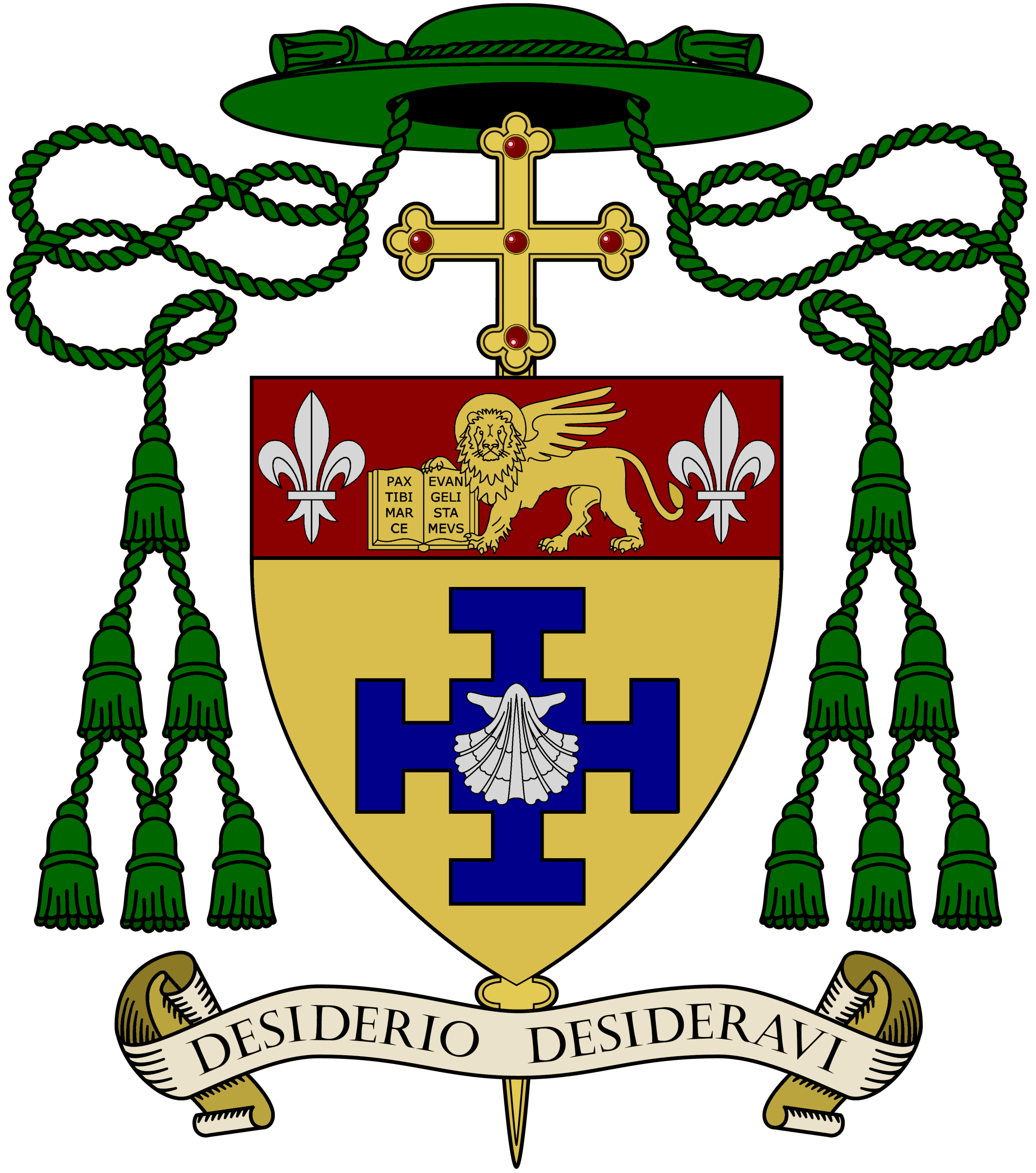
The Diocesan Archives
The diocesan archives are held at the Curial Offices, 50A The Avenue, Linthorpe, Middlesbrough TS5 6QT.
The achivist can be contacted by telephone on 01642 850505 ext. 238 or by e-mail at archives@dioceseofmiddlesbrough.co.uk
A Request from the Diocesan Archivist
I regularly get requests for information to help write the history of a particular parish; usually on the occasion of a jubilee. A list of the priests who have served such a parish can always be provided and maybe copies of photographs, newspaper clippings or an article from the Diocesan Yearbook. Sometimes a much greater wealth of material has been deposited (letters, diaries, church notice books, school log-books, records of organisations, parish census lists etc). From these a detailed picture can be drawn up, not only of the clergy who served a particular Catholic community over the years, but also of the community itself. Sadly this latter example is the exception rather than the rule - the plain fact is that for many of our parishes, apart from Sacramental Registers, little archival material has been preserved.
The purpose of this article is not to bemoan this fact, nor to discourage people from seeking information from the Archives, but to propose a simple practical step that could be taken to remedy this situation for the future.
My proposal is that someone in each parish starts compiling a chronicle of parish events as they happen. This could take the form of a diary or a scrapbook or maybe a combination of the two. One approach would be to accumulate copies of the parish newsletter in a ring binder with photographs, press clippings, diary entries etc inserted from time to time as the occasion arises. Compiling a parish chronicle, then, does not have to be an onerous task - it just needs someone with the initiative to start the process and the interest to maintain it over a period of time.
Finally, if such chronicles are to serve their purpose and be available to future generations it is essential that they are eventually deposited either in the Parish Archive, if one exists, or in the Diocesan Archives.
David Smallwood
Middlesbrough Diocesan Archives 2001-2
Survey of Parish Archives
All of the parishes in the East Riding have now been visited and the contents of their archives listed. At the time of writing about three quarters of the North Riding parishes have also been surveyed and it is hoped to complete this work before the end of 2002.
Both North Yorkshire and East Yorkshire County Record Offices have begun to microfilm/microfiche our earlier registers and for this we are very grateful. Because this is being fitted in with their own extensive microfilming programmes it will be quite some time before the work they are doing for us will be completed.
Archives Catalogue
The Inventory of the contents of the Archives reported last year has now been converted into a fully searchable computer database and a printed version of this is available as a finding aid for visitors. As the survey of parish archives progresses, information about material found in parishes is being added to the catalogue.
Some Recent Acquisitions
The following registers have been deposited in the Archives:
Bedale - St. Mary & St. Joseph (Baptisms: 1856-1936)
Grangetown - St. Mary (all)
Masham - St. Columba (Baptisms: 1910-25)
Volunteers
Several family history researchers have bemoaned the lack of a burial register for St. Mary's, Middlesbrough before 1959. As a partial remedy to this, Harry Gallagher has gone through the Church Notice Books for this parish and listed all the notifications of "recently deceased" giving names and dates. Not all of the Notice Books have survived, however, so this list only covers the dates 1876-83, 1916-19,1922-59.
Dr. Ann Hartley is continuing to transcribe registers in the Leyburn area.
Scale of fees for searching registers
Family history researchers are welcome, by appointment, to search registers in the Diocesan Archives free of charge. If postal enquirers wish that a search of the registers be carried out by the Archivist the following fees,
inclusive of postage, will be charged:
- Searching registers:fFor each hour, or part thereof £10
- Providing copies of entries:
- first certificate free
- next four certificates £5 each
- next ten certificates £3 each
- further certificates £2 each
- No charge will be made for producing a baptismal certificate for the purpose of marriage, or for entry to a Catholic school, or for entering religious life, but please provide full written details and a stamped, addressed envelope.
David Smallwood
